

How to design a Hospital/Healthcare space?
Space programming, planning, concept development, and detailed facilities, schematic design to outlining the overall layout and workflow is the beginning of any hospital design process. The architectural design is fully prepared with detailed drawings for regulatory approvals once the overall concept is matched with practicality and client's input. Simultaneously, civil and structural engineering design is also worked on to ensure the building's strength and safety, while MEP design covers all mechanical, electrical, sanitary, plumbing, water supply, and sewage management systems. To facilitate smooth, effective operations with all essential technical services like public address systems, tele-communication networks, HVAC, fire safety systems, and CCTV surveillance necessary, these areas are also addressed. Hospital design process completes with interior and exterior design, along with 3D visualisations for details that bring the final vision to life.
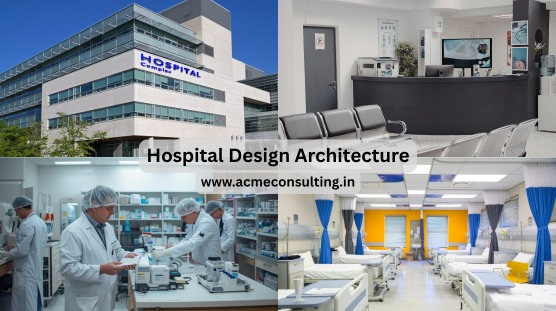
Healthcare Facility Design
Hospitals handle a load of unhealthy and healthy people at any given time making it a highly demanding setting. In hospitals, each metric from patient experience, clinical outcomes, healthcare professionals work efficiency, chances of acquiring infection, cross contamination, long-term operational coordination are impacted by healthcare facility design. Evidence-based research, risk-assessment frameworks, and international best practices are followed to create safe, adaptable, patient-centred spaces.
Fundamental Concepts and Vision
A medical facility is a healing ecosystem, most often they're designed with the same principle of other building out there while these facilities must be exclusively designed to heal: a space which promotes healing for patients, employee productivity, safety, infection-control, long-term versatility, and user comfort. Multiple stakeholders such as patients, employees, and visitors must be the priority of the design, which demands an architect to strike a balance among clinical functionality and sustainability, therapeutic nature, and human touch.
1. Designing Healthcare Facility
1.1 Hospital Planning, Concept Design & Space Programming
Architects and healthcare consultants work together to ensure Functional Planning Units (FPUs), this way all units are strategically positioned to fulfil their basis in the hospital without interrupting the overall operations. Designed based on the need and accuracy to minimise travel distances, optimise patient flow, and improve staff efficiency, FPUs help with maximum area optimization. In this primary phase, facilities and space programming establishes the vision, service mix, bed numbers, departmental adjacencies, and functional relationships impacting the overall outcome in the later stages.
1.2 Hospital Architectural and Schematic Design
Architectural design converts concepts into tangible layouts, master plans, and departmental drawings. This stage includes detailed architectural plans required for statutory approvals, zoning of clinical and non-clinical areas, circulation planning, and accessibility features.
1.3 Civil & Structural Engineering
Structural engineering ensures safety, durability, seismic resistance, and compliance with national building codes.
1.4 Hospital MEP Engineering
The efficient operation of a hospital is largely dependent on its MEP systems:
- >> Sanitary and plumbing design
- >> Provision of water and wastewater & sewage treatment
- >> Medical gas pipeline networks
- >> Emergency power, backup power, earthing, and electrical systems
1.5 Hospital HVAC Design
Effective HVAC maintenance is essential for:
- >> Infection control
- >> Quality of the air and purification
- >> Positive and negative pressure gradients
- >> Thermal comfort in vital spaces including isolation rooms, ICUs, and Ots
1.6 Hospital Fireproofing & Life Safety Systems
Patient safety depends on fire detection, containment, evacuation & rescue planning, compartmentalisation, and adherence with local fire regulations.
1.7 Hospital Information and Communications Technology & Systems
Health care facilities demand a complex IT and communication technology systems. Integrating these systems have become mandatory for efficient functioning with heightened awareness and patients' expectation shifting drastically from cure based to value-based preventive & hospitality care model. These increased demands for a comfortable yet curative environment requires incorporation of technology & systems in each area of the design. These systems include:
- >> Telecommunications and networks for information technology
- >> Communications systems for public address
- >> Systems for calling nurses
- >> Access control
- >> CCTV surveillance
- >> Building Management Systems (BMS)
1.8 Hospital Exterior and Interior Design
Patient satisfaction experience, safety & wellness, and performance are all improved by finishes, materials, lighting design, signage, and ergonomic layouts. Before construction begins, stakeholders may assess final designs with the aid of (Building Information Modelling) BIM models and 3D visualisations.
2. Evidence-Based Guidelines for Healthcare Facility Design
2.1 Evidence-Based Design (EBD) Approach
EBD incorporates clinical studies, statistical information of epidemiological studies, and measurable outcomes into architectural decision-making. Decisions such as:
- >> Single-patient vs. multi-patient rooms
- >> Hand-wash sink locations
- >> Lighting and ventilation levels
- >> Access control
Adjacent departments should be guided by information demonstrating their effect on both operational effectiveness and patient safety.
Patient-Centred & Healing Environment
Given the right to privacy, providing single-patient or small-bay wards with accessories can help patients and their attenders avoid commotion. To create a calming environment that has been shown to lower stress, promote healing, and increase patient satisfaction, use natural light, ventilation, views of the outdoors, and biophilic design (green areas, indoor plants, gardens, and access to daylight). Using soothing colour schemes, cosy interiors, and human-centered layouts accommodating quiet rest areas, family zones, and cosy waiting areas. These methods can markedly improve the comfort, providing a calm & healing space.
Efficient Workflow & Functional Zoning
Segmenting the healthcare facility into distinct zones: Public Areas/Reception & Waiting Room; Diagnostic, Imaging & Treatment (MRI, CT, laboratory, OTs); In-patient care (wards, ICU); Support areas and Utility zones (laundry, maintenance, services).
Ensure logical department proximity - critical services (emergency, ICU, diagnostics, OT) positioned for minimal trips and efficient process flow.
Plan circulation to segregate flows, separate circuits for patients, staff, materials, waste, and services to avoid cross-contamination and improve safety.
2.2 Safety of Patients and Staff as the Framework for Design
Physical design directly influences:
- >> Infection Transmission
- >> Falls by patients
- >> Medication errors
- >> Employee fatigue and injuries
- >> Visibility for supervision
Poorly planned layouts, inadequate hand-wash stations, or poor lighting can increase adverse events. Thus, safety must be embedded in the design as opposed to being added as a rule later. Techniques like Failure Mode and Effects Analysis (FMEA) help identify hazards in the design phase, before construction begins. Redesign expenses and long-term operational risks are decreased as a result.
With safety risks systematically mapped and mitigated early, designers can confidently adapt these principles across different healthcare facility types:
- >> Clinics & Day care units
- >> Small-Medium single/multi-specialty hospitals (10 to 100 bedded hospitals)
- >> Advanced single specialty and super-specialty hospitals
- >> Multi-specialty hospitals (>100 beds)
Hospital Redesign and Renovation
All these facilities, even with same healing environment require exclusive designing and detailed look out in order to avoid mishaps and to achieve its full potentials. Apart from these Greenfield designing, brownfield project planning and designing are setting trends on its own way. With increase land costs and lack of desired plot sizes, hospital redesigning has become a new norm in the sector. While planning, designing and execution of a new hospital can be highly demanding, redesigning an existing building can be quite a tiresome & heavy load. Redesigning and renovations affect the existing workflow, so you need healthcare experts, exclusive team of architects to help with the process,
"We at Acme Hospital Projects and consulting work exclusively in healthcare to help one achieve their dream facility.
Healthcare exclusive knowledge & architectural experience will help you model a facility of vision to life."
Any Queries, Write to Us @ contact@acmehospitalprojects.com
or Call / Whatsapp @ 9789803259 / 9840622244
Check Acme's Hospital Design Architecture Clients